
spinUP - Advanced Pulse Electron Spin Resonance Spectrometer (EPR) for Scientific and Industrial Applications
Experience Excellence with the spinUP Pulse EPR System
Welcome to the future of magnetic resonance. The spinUP pulse EPR system is an advanced, modular solution designed to meet the rigorous demands of modern scientific research. Because we prioritize both performance and usability, our platform empowers researchers to achieve high-precision results across various industrial and academic applications. Moreover, the system’s flexible architecture ensures that your laboratory stays at the cutting edge of technology, providing a seamless transition from standard experiments to complex pulsed sequences.
State of the
art capabilities
Affordable
price
Modular &
customized
Full personal
support
Quick and
simple upgrade
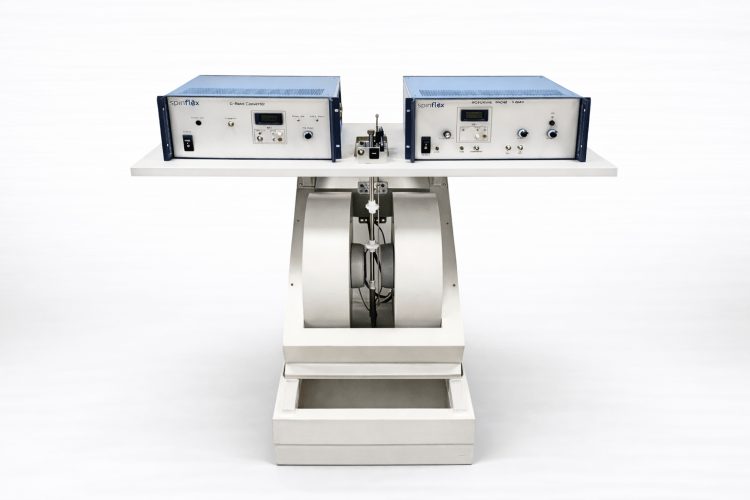
SpinFlex offers pulsed ESR instruments across 2–6, 6–12, 32–38, and 92–96 GHz. Upgrade any CW ESR system to pulsed ESR/ENDOR while keeping CW mode—both share the same magnet and switch instantly at the press of a button.


Hardware
A. Microwave Bridge To accommodate different research needs, spinUP provides several microwave bridge variants. These options depend entirely on your required frequency of operation within the pulse EPR system.
B. Pulsed ESR Spectrometer Furthermore, the entire spectrometer is conveniently housed in a single PC. This pulse EPR system is based on an open architecture that effectively combines commercial and proprietary PC cards for maximum flexibility.

Specifications
Parameter
S+C Band
C+X Band
Q Band
W Band
Frequency [GHz]
2÷6
6÷12
32÷38
92÷96
30
30
10
1
100-900*
125-250
Acquisition bandwidth [MHz]
0.5
0.5
0.5
0.5
Min pulse length [ns]*
5
5
5
5
Acquisition dead time [ns]**
10÷100
10÷100
10÷100
10÷100
2
2
2
2
* 0ns with AWG pulses
**Depending on the resonator and power
Software Solutions for Your Pulse EPR System
The spinflex software has been developed to support all levels of cutting-edge research. Consequently, it can be used by novices as well as the most advanced users. Our interface is focused on the researcher, which optimizes your time while delivering the highest flexibility for your pulse EPR system.
Moreover, our software allows you to control every parameter of your experiment. You can easily set or step parameters and run them as many times as you want. To streamline your workflow, the system enables you to save any desired configuration and setup for future use.
By choosing the spinflex pulse EPR system, you also benefit from years of experimental expertise. This is because our software leverages an extensive library of pre-configured and pre-defined experiment sets with tested scripts.
Finally, if you can’t find the specific setup or experiment you are looking for, our team is here to help. The software is highly flexible, and we are always willing to add more modules at no extra cost to ensure your research succeeds.
spinflex software has been developed to support all levels of cutting-edge research and can be used by novices as well as the most advanced users. It is focused on the researcher and optimizes the researcher’s time while delivering the highest flexibility.
Our software allows you to control every parameter of your experiment. Set it, or step it, and run it as many times as you want. Save your desired configuration and setup to be used from that point onward.
The software supports many different types of pulsed ESR spectroscopy, with pre-programmed sequences, such as: One-pulse FID; Two-pulse Hahn echo; Three-pulse inversion recovery; Three- and Four-pulse DEER, Pulsed ENDOR, CPMG, electrically-detected magnetic resonance (EDMR), optically-detected magnetic resonance (ODMR), and more. The software also supports many pre-defined types of phase-cycling, such as CYCLOPS, +/-, as well as any user-defines phase cycling procedure with as many as 128 steps.
Arbitrary pulses and complex timing changes can be programed through MATLAB™ scripts. The software also supports the real-time processing of the acquired data through pre-configured or user defined MATLAB™ scripts.
With spinflex software, you get to benefit from years of experiments that were run with our systems by leveraging an extensive library of pre-configured and pre-defined experiments sets with tested scripts.
Can’t find the setup or experiment you are looking for? The software is flexible and our team is always willing to add more modules at no extra cost.
Capabilities
Feature
Properties
Pre-programmed pulse sequences
- One-pulse FID
- Two-pulse Hahn echo
- Three-pulse inversion recovery
- Three- and Four-pulse DEER
- Pulsed ENDOR
- CPMG
- EDMR
- ODMR
Pre-defined types of phase-cycling
- CYCLOPS, and +/-
- Any user-defined phase-cycling procedure with as many as 128 steps
Advanced flexible capabilities
- Arbitrary pulses and complex timing modifications can be programed through MATLAB™ scripts
- Supports real-time processing of the acquired data through pare-configured or user- defined MATLAB™ scripts
Inside the spinUP: System Architecture
Every spinUP spectrometer is built around microwave bridges and control software developed by Spinflex, combined with high-speed commercial PC boards in an open architecture. The main subsystems are:
- Microwave bridges by Spinflex – S-band and X-band bridges, with Q-band and W-band operation achieved by up- and down-converting the X-band signal. All bridges generate pulses with precise timing, amplitude and phase control and provide phase-sensitive (I/Q) detection.
- Two-channel arbitrary waveform generator – 14-bit, up to 2 GS/s. Channel 1 drives the microwave bridge; channel 2 generates RF pulses for ENDOR, NMR and DNP experiments.
- Nanosecond pulse and timing generator – switches the system components with nanosecond precision, synchronized to the intermediate frequency by a Spinflex clock-synchronizer board for coherent detection.
- Fast digitizer with hardware averaging – two channels at up to 1 GS/s with 1 GHz analog bandwidth, acquiring and averaging the in-phase and quadrature signals.
- Magnetic field control – a Hall-probe gaussmeter with an integrated PI loop drives the magnet power supply for stable field setpoints, with bipolar and unipolar operation.
- ESRM1 control software – developed in the Magnetic Resonance Laboratory of Prof. Aharon Blank at the Technion, with a Tune Mode wizard, a field-sweep wizard, interlaced scripts and user-defined phase cycles.
Compatible Magnets and CW-to-Pulse Upgrades
The spinUP spectrometer can operate with nearly any commercially available electromagnet, which makes it a natural path for laboratories moving from CW EPR to pulsed EPR. Systems have been integrated with:
- conventional laboratory electromagnets, including GMW and Varian magnet systems;
- the compact spinMAG magnet by Spinflex;
- high-field cryogenic superconducting magnets (for example, a 4 T magnet with cryostat).
Because the magnet, power supply and much of the existing infrastructure are reused, upgrading an existing CW instrument is usually the most cost-effective way to add pulse EPR and ENDOR capabilities. Read more in CW EPR vs. Pulse EPR – and How to Upgrade.
Frequently asked questions
Can spinUP work with my existing magnet?
In most cases, yes. spinUP is designed for broad compatibility with commercial electromagnets and also supports cryogenic superconducting magnets. Contact us with your magnet model and we will confirm compatibility.
Do I need programming experience to use the software?
No. ESRM1 runs as a standalone application with predefined methodologies and wizards. Advanced users can add MATLAB scripts, interlaced scripts and custom phase cycles.
Which experiments are pre-programmed?
FID, Hahn echo, inversion recovery, three- and four-pulse DEER, pulsed ENDOR, CPMG, EDMR, ODMR and more – see the Capabilities table above.
Request a quote for a complete spinUP system or a CW-to-pulse upgrade.
Examples of experimental results

Two-pulse Hahn echo
Spin-spin relaxation data of [Y(pc)2]*
crystals via two-pulse Hahn echo.

CPMG sequence
ESR signal from a sample of phosphorus-doped si28, measured by a CPMG sequence with 226 π pulses.

ENDOR
Davies ENDOR signal of Malonic acid single crystal, at Q-band.

DEER decay

Four Pulse DEER
4-Pulse DEER data for nitroxide bi-radical measured at room temperature with Gaussian pump pulse (Q band, microwave power of 5 W).

Inversion Recovery
Inversion recovery sequence:
Spin-lattice relaxation data of radical defects in teeth enamel via inversion recovery experiment.

Field sweep comparison
Field sweep echo data acquired for a standard DEER sample with the Bruker Elexsys-580 and SpinUp systems.

DEER comparison
Four pulse DEER data acquired for a standard DEER sample with the Bruker Elexsys-580 and SpinUp systems.
Contact Us
Further Reading on Pulse EPR & Structural Biology
spinUP vs. Bruker E-580: Pulse EPR Benchmark Results (Spinflex)
CW EPR vs. Pulse EPR – and How to Upgrade (Spinflex guide)
DEER / PELDOR: Measuring Protein Distances with Pulse EPR (Spinflex guide)
The Role of EPR in Modern Structural Biology (Research Paper)
Comprehensive Guide to Electron Paramagnetic Resonance (Wikipedia)